Amina Khalid Muhammad
The Federal Government, on Tuesday, rolled out new incentives aimed at attracting agricultural investments and tackling the country’s rising food crisis.
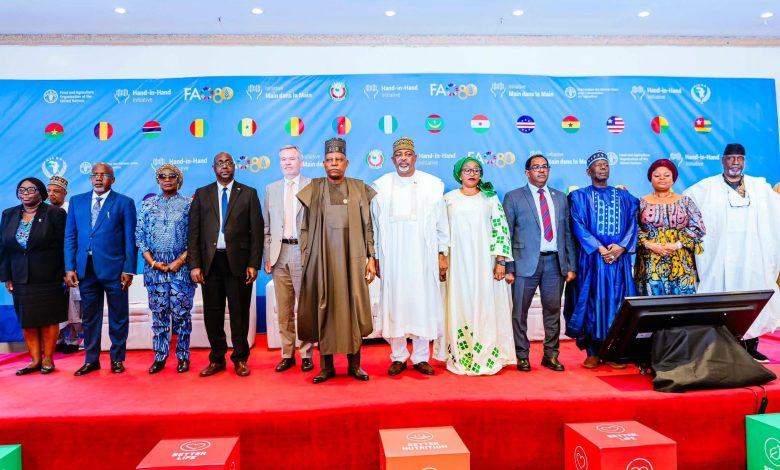
Vice President Kashim Shettima, who unveiled the plan at the Food and Agriculture Organisation’s (FAO) National and Subregional Hand-in-Hand Investment Forum in Abuja, said the measures align with President Bola Tinubu’s economic agenda to expand irrigation, improve access to credit and create millions of rural jobs.
In a statement by his Senior Special Assistant on Media and Communications, Stanley Nkwocha, Shettima listed the incentives to include a single-window platform for land registration, strengthened agricultural credit systems, large-scale mechanisation and strategic irrigation projects.
The Vice President lamented that Nigeria has the capacity to irrigate over three million hectares of farmland but is currently utilising less than 10 per cent of that potential.
“Strategic investment in irrigation alone could triple yields, free us from seasonal dependency and fortify our resilience against climate shocks,” Shettima said.
Describing hunger as the “great equaliser,” he stressed that food security is not only about survival but also about global stability.
Nigeria’s 2021–2025 National Development Plan, according to him, is designed to lift 35 million people out of poverty, create 21 million jobs in rural communities and ensure food and nutrition sufficiency.
He assured investors that ongoing regulatory reforms, public-private partnerships and agri-tech innovations were proof that “Nigeria is open for business.”
“Let us work hand-in-hand to build a Nigeria and a subregion where no one goes to bed hungry, where rural communities are hubs of wealth creation, and where agriculture is the true foundation of our prosperity,” Shettima added.
Minister of Agriculture and Food Security, Abubakar Kyari, also noted that Nigeria’s vast arable land, huge domestic market and fast-growing digital economy present unique opportunities for investors across the agribusiness value chain.
On his part, Minister of Budget and Economic Planning, Senator Atiku Bagudu, said agriculture and irrigation remain Nigeria’s untapped potential for diversification and economic transformation.
Gambia’s Minister of Agriculture, Livestock and Food Security, Dr Demba Sabally, commended Nigeria’s strides in rice and cassava value chains, calling them models for the sub-region. He also urged for stronger peer review among West African nations to confront common challenges.
Similarly, FAO’s Representative in Nigeria and ECOWAS, Dr Hussein Gadain, described the Hand-in-Hand Initiative as a flagship programme to drive agricultural transformation and sustainable rural development. He hailed Shettima’s “visionary leadership” and commitment to strengthening Africa’s agri-food systems.
The Head of the EU Delegation in Nigeria, Mr Gautier Mignot, reaffirmed the bloc’s support, noting that the EU recently committed over €80 million to boost value chain development across seven states.
The new incentives come at a time when food inflation, climate shocks and the impact of fuel subsidy removal have worsened food insecurity, intensifying calls for long-term solutions in the sector.