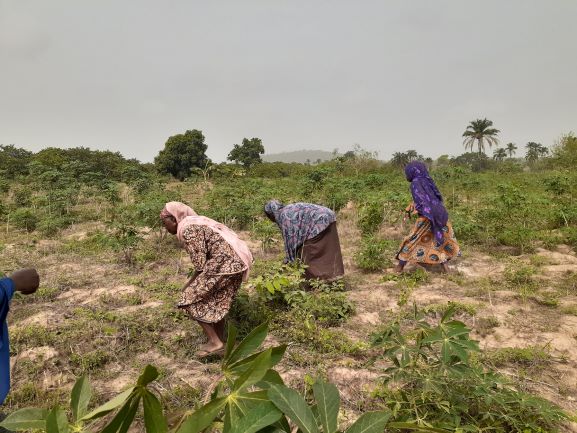
ActionAid Nigeria (AAN) and the Small-Scale Women Farmers Organisation in Nigeria (SWOFON) have urged the three tiers of government to invest in community-level storage and processing infrastructure.
They said the initiative would reduce reliance on middlemen and improve the income retention capacity of smallholder farmers.
The call was made on Saturday in Abuja during the presentation of a Community Scorecard titled “Smallholder Women Farmers (SHWFs) Access to Post-harvest Loss Reduction Support in the Federal Capital Territory (FCT) between 2022 and 2024.”
Experts define smallholding or smallholder farming as a model involving small farms operating under a small-scale agricultural system.
The scorecard was presented by Chika Orji, Lead Co-Creator and Team Lead of the Scaling Up Public Investment in Agriculture Project (SUPIA).
Orji said data from the scorecard revealed that 66.7 percent of SHWFs from Abuja Municipal, Bwari, and Kuje Area Councils rated government support for post-harvest loss reduction as inadequate.
She noted that one of the major challenges faced by SHWFs is the exploitation by middlemen, largely due to the lack of facilities or support systems to reduce post-harvest losses.
Other challenges, according to her, include insufficient processing equipment such as rice milling and garri processing machines, grain dryers, limited access to good road infrastructure, and the absence of warehouse facilities.
“Other issues include the unavailability of solar panels, deep freezers, cold rooms, and other storage facilities for livestock; the reduced number of off-takers for market opportunities; lack of access to markets and linkages; absence of warehouses; insecurity and safety concerns; weak government interventions; and poor inclusivity of women in decision-making processes,” she said.
Orji recommended that governments at all levels should prioritise addressing insecurity and mitigate farmer-herder conflicts within farming communities.
She further called for investment in the construction and rehabilitation of rural access roads to farming areas to ensure food security.
“Government interventions should be expanded beyond tomato processing to cover a wider range of crops, livestock value chains, and agro-processing skills for women farmers.
“Government policy must be reformed to emphasise agriculture in a way that facilitates access to infrastructure and reduces post-harvest losses,” she added.
Orji said records showed that although there were budgetary provisions for agricultural extension services and post-harvest loss reduction in the FCT between 2022 and 2024, there was no available information on the actual release of the funds.
“We recommend that both local and sub-national governments ensure full implementation of budget lines dedicated to post-harvest loss reduction.
“We also recommend that government promote inclusive financing mechanisms such as grants, low-interest loans, or revolving funds tailored for SHWFs and their cooperatives,” she said.
Orji explained that the scorecard was co-created through a participatory process led by AAN and SWOFON under the SUPIA project across the FCT.
She said the objective was to assess SHWFs’ access to post-harvest loss reduction support in the territory and to advocate improved support for the farmers.
“It is meant to provide information on SHWFs’ rating and access to post-harvest loss reduction support for government officials, the media, and the public.
“It also aims to strengthen women’s voices in governance by building their capacity to influence agricultural policies and advocate targeted interventions that reduce post-harvest losses,” she added.