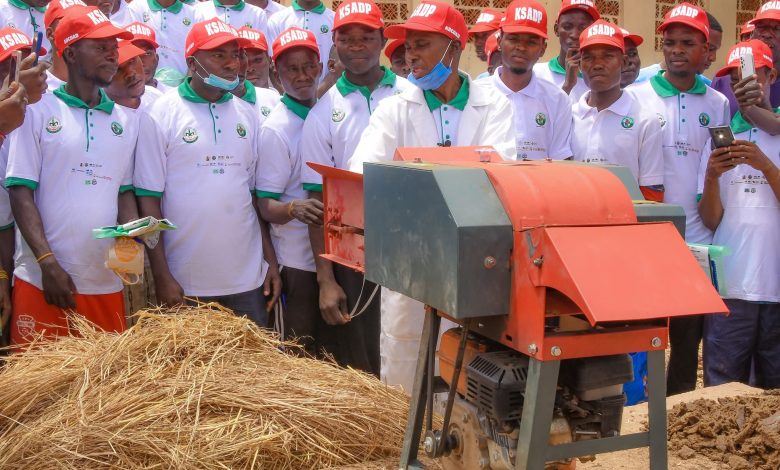
In a move to empower young people and tackle agricultural waste, the Kano State Agro-Pastoral Development Project (KSADP) has begun training 1,000 youths on how to turn rice straw into livestock feed.
The training, which kicked off at the Audu Bako College of Agriculture, Dambatta, targets youths from rice-producing communities across the state. It is being funded by the Islamic Development Bank and the Lives and Livelihoods Fund as part of efforts to create job opportunities and boost rural incomes.
Speaking during the launch of the training, the State Project Coordinator of KSADP, Ibrahim Muhammad, said the exercise is a step towards sustainable agriculture and peacebuilding.
“This training on rice straw utilisation is crucial for promoting sustainable agriculture and creating economic opportunities,” Muhammad said. “By educating the youths about the various uses of rice straw instead of burning, such as composting and livestock feed, it can lead to reduced environmental pollution and increased income generation.”
He noted that as rice production in Kano continues to rise, much of the straw is either burnt or used for roofing, wasting its potential as animal feed.
“It was realized that rice production in Kano is increasing, but the utilisation of rice straw is still minimal, with most farmers burning it to prepare the land for dry season farming or using it to thatch their roofs. However, rice straw can be treated with urea and fed to livestock to achieve reasonable weight gains,” he said.
Muhammad added that increasing the availability of livestock feed could help reduce nomadic movements, which sometimes trigger security concerns.
“With increased availability of the livestock feed from local rice fields, nomadism, which sometimes results in security challenges, will be minimized,” he said, adding that “the initiative has the potential to ensure improved relations between farmers and herdsmen in Kano.”
To support this initiative, he said KSADP is planning to establish 200 production hubs around irrigation schemes. Each group of five youths will be given machines and financial support to produce and market urea-treated rice straw feed.
“We have already procured machines. During the harvest season, each group of five youths is expected to produce and sell 500 metric tonnes of the feed. This activity will increase the availability of crop residue for livestock in the State,” Muhammad explained.
The Provost of Audu Bako College of Agriculture, Professor Muhammad Wailare, expressed the institution’s delight in hosting the training.
“We are happy to co-organize this training. The beneficiaries will be exposed to various simple technologies on rice straw utilisation that will not only facilitate income generation but also promote sustainable agricultural practices and reduce environmental pollution,” he said.