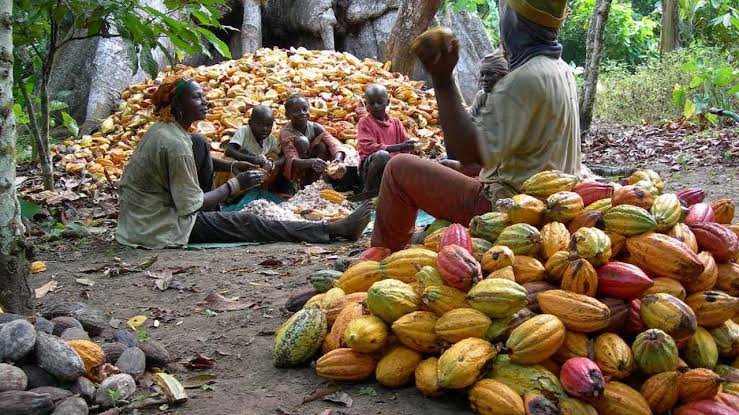
Stakeholders in the cocoa industry have revealed that the market, with an annual volume of 250,000 tons, is currently valued at over $6 billion. However, with global cocoa prices now surging to $10,000 per ton, the market value could potentially reach $25 billion.
This insight was shared during the 25th Anniversary and Awards Ceremony of Starlink Global & Ideal Ltd. in Lagos, where stakeholders emphasized the role of cocoa and other agricultural commodities in Nigeria’s economic diversification.
Chief Executive Officer of Starlink, Alhaji Adeyemi Adeniji, highlighted the potential of the cocoa sector to drive significant economic growth.
He stated, “The cocoa market, in terms of volume, is just about 250,000 tons, but in terms of value, it is about $6 billion or more, depending on the international market price. Today, the price of cocoa has risen to $10,000 per ton. This means Nigeria’s cocoa exports could generate $25 billion, underscoring the potential of the sector.”
Adeniji also called on the government to implement policies that support industrialization through backward integration. He revealed that Starlink has partnered with Odu’a Investment to manage 25,000 hectares of farmland across West Africa.
The partnership aims to develop two pilot sites of 5,000 hectares each, with plans to scale up operations over the next five years.
Additionally, Adeniji announced the acquisition of Nigeria’s largest cocoa processing factory, set to commence operations by April 2025. The facility will produce finished products such as chocolate and cocoa drinks, advancing the value chain and boosting local production.
Chief Bimbo Ashiru, Chairman of Odu’a Investment Group, emphasized the need for Nigeria to transition from an oil-dependent economy to one centered on agriculture. He noted that the Minister of Trade and Investment is working to attract investors and enhance the ease of doing business, aiming to generate over a trillion dollars annually from agriculture.
Ashiru also pointed out that Nigeria is focused on reviving cocoa production, which was a major export in the 1970s, to improve food security and create export surpluses.
He explained, “The strategy is to make Nigeria non-oil dependent. We have so much in agriculture that leads to industrialisation. We have no business being an import-dependent economy. We should be exporting more, and the strategy is over a trillion dollars a year so that once we have that, we’ll be less dependent on oil. The point is this: as a country, Nigeria was the second largest exporter of cocoa in the world in the 70s. We went wrong when we found oil. But now we should go back to that basis and start doing that, and that is the focus, and that’s what we are looking at now in Nigeria.”
Mr. Olusegun Obasanjo, National Coordinator for the African Continental Free Trade Area (AfCFTA), praised Starlink Global for its contribution to Nigeria’s economic growth and urged the company to evolve into an export trading firm.
He stated, “Companies like Starlink Global have a chance to perform incredibly well. I’ve told them they should see themselves as an export trading company, not only in commodities but also in finished goods. Together, we can unlock the full potential of AfCFTA to drive growth, job creation, and economic development in Africa.”
With the ongoing surge in global cocoa prices, coupled with investments in infrastructure and policy support, Nigeria is positioned as a key player in the global cocoa market. Stakeholders believe that tapping into agriculture’s full potential will not only diversify Nigeria’s economy but also strengthen the naira through increased foreign exchange earnings.