The Institute for Agricultural Research (IAR), Ahmadu Bello University, Samaru, Zaria, has unveiled newly-released short and medium-statured sorghum cultivars.
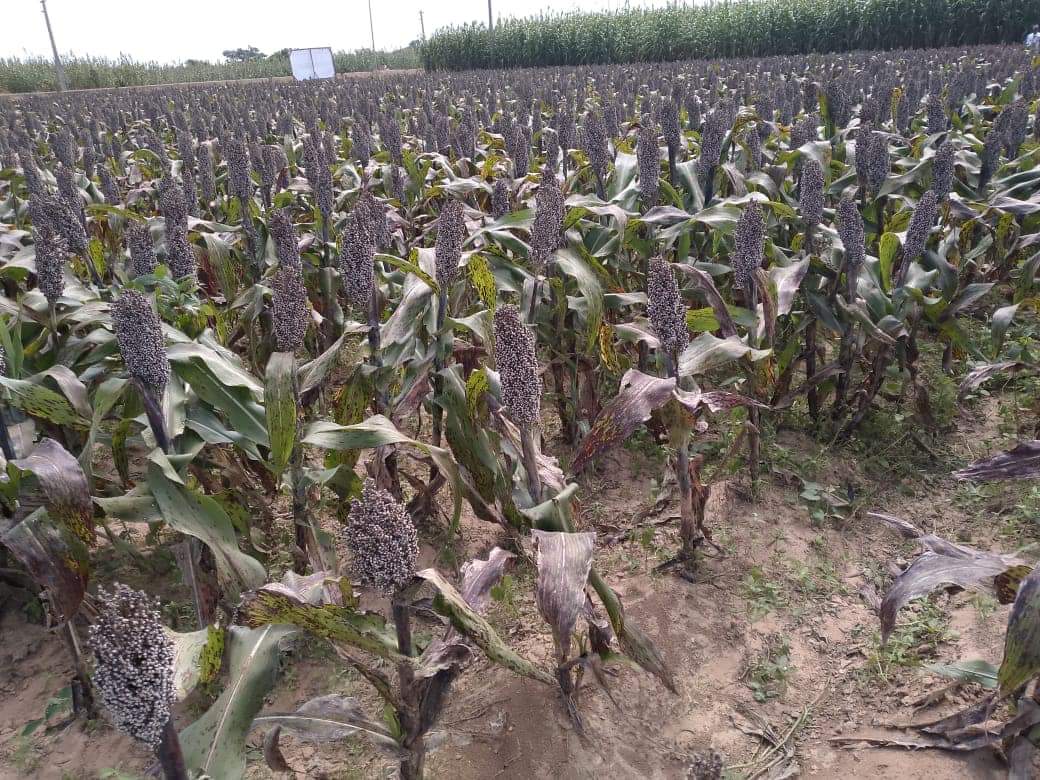
The demonstration of the new sorghum varieties—SAMSORG 52, SAMSORG 53, and SAMSORG 54—took place during a Field Day in Bagadawa, Dawakin Tofa Local Government Area, Kano State.
Speaking at the event, Executive Director of IAR, Professor Ado Yusuf, represented by the Assistant Director of Research, Professor Luscious J. Bamaiyi, highlighted that the sorghum varieties were the result of rigorous research aimed at improving food security. “Sorghum is an ancient crop, even older than maize, and it holds significant potential for enhancing food security,” he said.
Bamaiyi explained that SAMSORG 52, released in 2023, is an early-maturing variety that reaches maturity in 85-90 days, with a height of less than one meter and a potential yield of 3.5 tons per hectare. “It is particularly suited to the Sudan/Sahelian regions, where the rainy season is short,” he noted.
SAMSORG 53 and SAMSORG 54, also released in 2023, are medium-maturing varieties that take 95-100 days to mature. These varieties are adapted to the Sudanian and Northern Guinea Savannah, offering yields of 3.7 and 3.8 tons per hectare, respectively. “These varieties have excellent grain and biomass yield and are suitable for both rainy and dry seasons, including under irrigation. Their leaves can also be used for livestock feed, offering farmers multiple benefits,” Bamaiyi added.
He assured farmers of the institute’s continued support, while also thanking the Kano Agricultural Research Development Agency for hosting the event.
Lead Agronomist of IAR, Prof. J.A.Y Shebanya, emphasized the importance of proper planting techniques to ensure a bumper harvest. He acknowledged the challenges farmers face with inconsistent rainfall and explained how the new varieties address these issues.
In his remarks, Dr. Angarawai Ignatius, Country Director of the International Crops Research Institute for the Semi-Arid Tropics (ICRISAT), emphasized that the development of these varieties aims to tackle the challenges posed by climate change and insecurity. “We developed these varieties to enable early harvesting with combined harvesters, helping farmers avoid risks posed by insecurity in some regions,” he said.
Dr. Angarawai concluded by stressing the significance of showcasing the newly-released varieties to farmers, noting that they are designed to address current agricultural challenges.