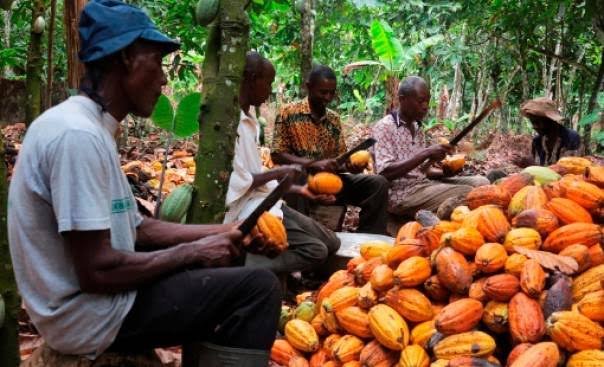
Many youths in the Southwestern states, particularly Osun, Ondo, and Ekiti, are returning to their villages to acquire land for cocoa farming, following the recent surge in cocoa prices on international markets.
A survey by the News Agency of Nigeria (NAN) revealed that youths are leaving other jobs or transitioning from various occupations to take advantage of the increased market value of cocoa beans.
In separate interviews with NAN, some of the youths appealed to the government for support to boost cocoa production.
A 43-year-old cocoa farmer in Osogbo, Adekunle Opatoyinbo, said he inherited a large cocoa farm from his late father but returned to the village after realizing that cocoa prices had risen significantly.
Opatoyinbo, who said he had been unable to secure a job after graduating from university in 2015, noted that the cocoa business he eventually ventured into had positively improved his fortune.
He explained that due to the increase in cocoa prices, many young men and women—mostly unemployed—were now acquiring land for cocoa plantations.
According to him, many acres of land are now being purchased by young farmers hoping for profitable returns from cocoa farming.
He, however, noted that bad weather conditions, pests, and a lack of modern equipment remain significant challenges in cocoa farming.
Another young cocoa farmer, Seyi Adegboye, said the profits he made from cocoa enabled him to build two houses.
Adegboye added that many unemployed youths are embracing cocoa farming due to its profitability.
Similarly, Mr. Abimbola Adewole, General Secretary of the Cocoa Growers Association (CGA) in the state, confirmed that more youths are joining the cocoa farming business due to the surge in global prices.
Adewole noted that even youths in the diaspora are acquiring land for cocoa farming and hiring workers to manage the farms on their behalf.
He added that the adoption of modern cocoa cultivation methods has enabled older farmers to earn substantial income and live comfortably.
“I’m almost 80 years old and was born into a cocoa farming family. When we were younger, we always worked on the farm during weekends.
“Back then, we used crude and harsh farming methods, but modernization has changed everything.
“Now there are tractors for farming, machines for applying and spraying chemicals, and improved cocoa seedlings for better yields.
“Many youths are now inspired to join the cocoa farming business because they see the turnaround and profits older farmers are making.
“Cocoa farmers now use the necessary chemicals and modern technology to boost production, leading to increased yields and profits,” he said.
He also explained that cocoa is a cash crop that takes up to three years to produce pods, giving farmers ample time to nurture the plants for a bountiful harvest.
Adewole appealed to more youths to join the cocoa revolution and value chain, highlighting its growing profitability.
He urged the government to establish cocoa processing companies so cocoa can be processed into finished products locally before being exported.
Adewole described the proposed establishment of the National Cocoa Management Board (NCMB) as a laudable initiative by the Federal Government, recommending that it be domiciled in a cocoa-producing region for maximum effectiveness.
The Chairman of the Cocoa Growers Association in Ife East Local Government Area, Alhaji Fatai Seidu, attributed the surge in cocoa prices to fluctuations in foreign exchange.
According to Seidu, when a country’s currency is weak, the value of cocoa exports increases in foreign markets, leading to higher prices.
He described the recent price increase as a reward for cocoa farmers’ years of hard work.
Mr. Raphael Oladipupo, a young farmer in Ile-Ife, said the unprecedented surge in cocoa prices has drawn many youths into the business.
He explained that the rise in cocoa prices motivated many young people to return to their villages and acquire farmland for cocoa cultivation.
“More than ever before, many young people are now acquiring land for cocoa farming as an alternative source of income,” he said.
Another young cocoa farmer in Ile-Ife, Mr. Oluwatosin Peter, said he saw cocoa farming as an opportunity to earn more than his monthly salary.
“It’s an opportunity that must be seized because of its income potential. I’m an accountant, but my salary isn’t enough.
“With cocoa farming, I earn something substantial to supplement my income. Eventually, I’ll focus solely on cocoa farming because it’s lucrative,” he said.
Peter, however, identified pests, diseases, climate change, low soil fertility, and environmental degradation as challenges facing cocoa farming.
Another farmer, Mr. Ade Kuboyejo, said he chose cocoa farming because of its high economic value.
“I inherited the farm from my father. My family supports me in this business. I use it to train my three children. Given the current economic situation, I have no complaints; I’m focused on farming,” he said.
In Ondo State, Mr. Sadiq Saliu, a 40-year-old farmer who has been engaged in cocoa farming for over a decade, said the proceeds from the 2024 cocoa production season significantly improved his life.
Saliu explained that the new cocoa varieties, coupled with rising prices, have enabled farmers to “smile to the bank.”
“Engaging in cocoa farming has been a blessing. Now, I can confidently converse with my age mates living in the city.
“However, we face major challenges, including herdsmen invading farms, unavailability of labor, and expensive chemicals.
“Herdsmen no longer graze openly but now invade the forests where we cultivate cocoa and other crops. The workers we hire charge no less than N300,000 annually per person.
“Government intervention is lacking. We need subsidized chemicals and tools because prices are too high,” he said.
Mr. Femi Babatunde, a cocoa merchant in Ondo State, told NAN that skyrocketing cocoa prices have attracted more young people to the sector.
“The sharp increase in cocoa prices—from around $2,200 per metric ton in 2022 to nearly $11,000 by late 2024—has sparked interest among young professionals, including former engineers, bankers, and scientists.
“This trend is evident in areas like Ikom in Cross River State, and parts of Ondo and Osun States.
“Drawn by profitability, many of these individuals have joined the Cocoa Farmers Association of Nigeria, signaling a shift toward agriculture as a viable career path,” he said.
He noted that despite this positive trend, the average age of Nigerian cocoa farmers remains around 60, highlighting the need to further engage the youth for the sector’s long-term sustainability and innovation.
Babatunde said recent innovations in cocoa seedlings are another reason young Nigerians are turning to cocoa farming.
“Breakthroughs in agricultural research have produced cocoa strains capable of bearing fruit in under two years.
“Institutions like the Cocoa Research Institute of Nigeria (CRIN) are leading these innovations, which aim to improve productivity and reduce time to harvest.
“These fast-maturing varieties promise higher yields and quicker returns on investment, which are attractive to younger farmers,” he said.
Mr. Dayo Ogundare, a member of the Ondo State Cocoa Council and former chairman of Sunshine Cocoa Farmers, commended the Federal Government for the NCMB initiative.
Ogundare said the initiative would enhance growth in the cocoa value chain, especially in cocoa-producing states.
“With this initiative, the era when buyers, farmers, exporters, and processors operate independently and haphazardly will end.
“The Federal Government must ensure proper discipline and management within the board for the benefit of all stakeholders,” he said.
He also called on the government to construct rural roads and control the activities of loggers in cocoa-producing areas.
“In every hectare of cocoa farmland, there should be at least 18 trees to provide shade. But loggers often cut down matured trees and destroy farms,” he noted.
Ogundare encouraged youths to engage in cocoa farming and discard the notion that farming is for poor people.
“As of now, a kilogram of cocoa sells for N10,000. If you have 100 kilograms, that’s over a million naira. I encourage youths to go into cocoa farming and make money,” he said.
In Ekiti State, an agricultural expert, Mr. Juwon Ogunbiyi, said the return of young people to village farmlands for cocoa farming is driven by a mix of economic opportunities and government support.
He explained that the search for a fulfilling life and sustainable income has contributed to this trend.
Ogunbiyi said cocoa farming, when properly managed, can provide significant income compared to other employment options.
He added that many young people now see cocoa farming as a way to build businesses by offering services like farm management, input supplies, and market gardening.
“By engaging in cocoa farming, young people can potentially escape poverty and create a stable future for themselves and their families,” he said.
According to him, many are also drawn to a rural lifestyle, greater community connection, and improved rural infrastructure supported by the government.
“Young people are embracing modern farming techniques to increase yields and improve the quality of their cocoa. They are developing strategies to sell directly to buyers and maximize profits.
“Through cocoa production, they improve their livelihoods and contribute to community development,” he said.
Another agricultural expert, Mr. Kayode Obayemi, said cocoa farmers face serious challenges such as deforestation, ageing plantations, poor farm management, soil degradation, and pest infestations.
Obayemi noted that the misuse or overuse of pesticides and chemical fertilizers in many cocoa farms..