By Zulaiha Sani Haruna
Nigeria’s Vice President, Kashim Shettima, on Thursday said the country can save over N3 trillion annually in fuel and ethanol imports through a new cassava bioethanol project aimed at transforming cassava from a food staple to an industrial asset.
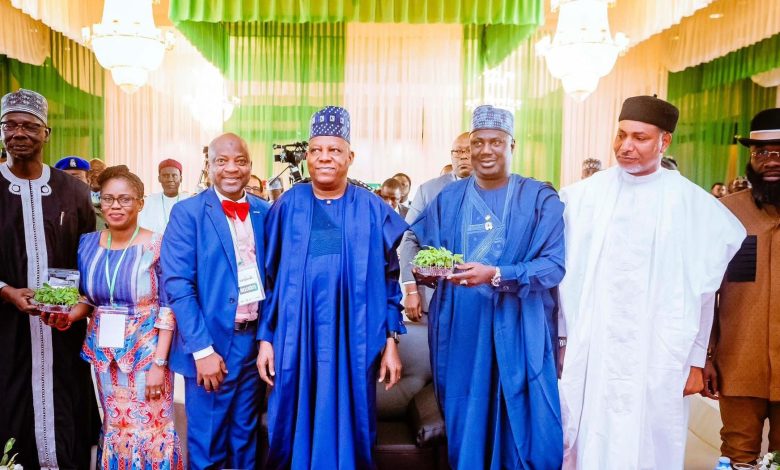
Speaking at the first-ever World Cassava Day celebration held at the State House Banquet Hall in Abuja, Shettima said the new initiative under President Bola Ahmed Tinubu’s administration will focus on mechanisation, agro-processing, and youth involvement to change Nigeria’s cassava narrative.
“It is no longer acceptable for Nigeria to lead in cassava production but lag in value addition and exports,” the Vice President said.
While Nigeria is the world’s largest cassava producer, Shettima noted that past administrations have failed to industrialise the crop, limiting its economic potential.
He described cassava as “not just a crop but a platform for economic reengineering,” with the capacity to drive industrial supply chains, import substitution, and create jobs in rural areas.
Under the government’s Renewed Hope Agenda, over 2,000 tractors and 50 bulldozers will be deployed to expand cultivated land, while the Nigeria-Brazil Strategic Dialogue Mechanism is already mobilising over $1 billion for mechanisation and technical training.
The government is also encouraging Nigerian youth to tap into cassava’s potential through targeted support from the Bank of Agriculture, Bank of Industry, and National Agricultural Development Fund.
Shettima praised Nigeria’s partnerships with countries like Brazil, known for turning its once-barren Cerrado region into a food production hub, and Ethiopia, whose cluster farming model is inspiring similar approaches in Nigeria.
Delivering a message on behalf of Cavista’s Chairman, Mr. Niyi John Olajide, Mr. Olumide Olayomi applauded the government’s cassava initiative and described the crop as a “strategic asset in Nigeria’s journey toward economic diversification, rural empowerment, and global competitiveness.”
Cavista’s cassava project, Agbeyewa Farms in Ekiti State, has expanded from 102 hectares to over 5,000 hectares in two years, with plans to reach 10,000 hectares by 2026. The farm boasts yields four times higher than the national average and is backed by a N1.5 billion mechanisation fleet.
Oscar Seyi Ayeleso, Agbeyewa’s Managing Director, highlighted the farm’s use of drone-enabled input application, guaranteed offtake arrangements for community farmers, and integration into value chains for starch, flour, and other cassava-based products.
In his remarks, Dr. Kingsley Uzoma, Senior Special Assistant to the President on Agribusiness, said the World Cassava Day celebration will now become an annual platform to measure growth and accountability in the sector.
“Nigeria is the largest producer of cassava in the world, but production alone is not enough. The real opportunity lies in value addition and market access,” Uzoma said.